I thought I was being smart.
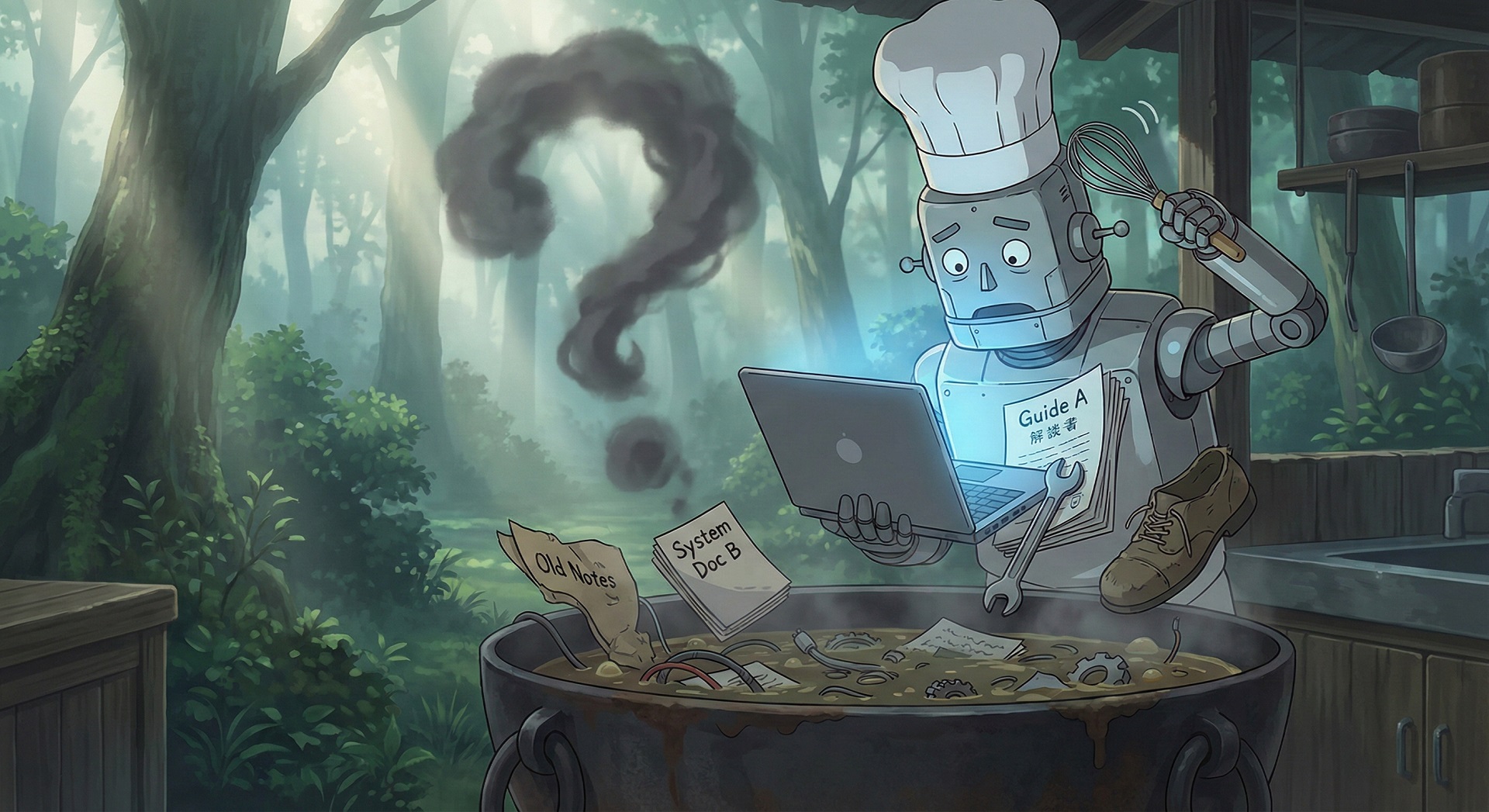
I had dozens of user guides, and system documentation GDocs scattered across my drive. So I did what seemed obvious in 2026 I imported everything into NotebookLM. Every single guide. All at once and thought magic will happen.
“Now the AI has access to everything,” I thought. “It’ll be amazing.”
Then I asked a simple question about a specific feature.
The AI gave me an answer. But it was wrong. Not completely wrong but worse than that. It was a mix of information from three different guides. The AI is unable to understand the question identify which guide to go.
I had given the AI more context, and somehow got worse results.
That’s when it hit me: Having context isn’t enough. You need to manage it.
What I Learned the Hard Way
In 2025, I wrote about meta-prompts and how to craft better prompts. Meta-prompts worked great for refining my questions and getting better responses.
But then I started using NotebookLM, and something unexpected happened.
I thought giving AI access to all my documentation would make everything even better. Instead, it opened my eyes to something I’d completely overlooked: context management matters just as much as prompt engineering.
The problem wasn’t how I was asking it was how I was organizing what I gave the AI to work with.
What Changed in 2026
The AI models got smarter. Not just incrementally better fundamentally different in how they understand us.
The old way (2024-2025):
- Models were literal. “Write code” != “Write clean, production-ready code”
- You had to specify every constraint
- Ambiguous phrasing > Model gets confused or refuses
- English fluency mattered
The new reality (2026):
- Models infer “best practice” defaults automatically
- If you ask for code, it assumes you want it runnable
- Models use reasoning to bridge gaps in your phrasing
- “Bad English” still yields “Good Logic”
The result: Prompt engineering is still important, but relatively less critical than it used to be. The bar for “good enough” prompts got much lower.
The Shift: From “How” to “What”
| Old Focus (2024-2025) | New Focus (2026) |
|---|---|
| ❌ “What magic words do I use?” | ✅ “Does the AI have the right context?” |
| ❌ Optimizing sentence structure | ✅ Organizing files and data properly |
| ❌ Copy-pasting context manually | ✅ Consolidating data into unified platforms |
| ❌ “Act as an expert…” | ✅ “Here are the actual files…” |
Bottom line: Stop obsessing over how you ask. Start obsessing over what you provide.
The “Garbage In” Problem (GIGO)
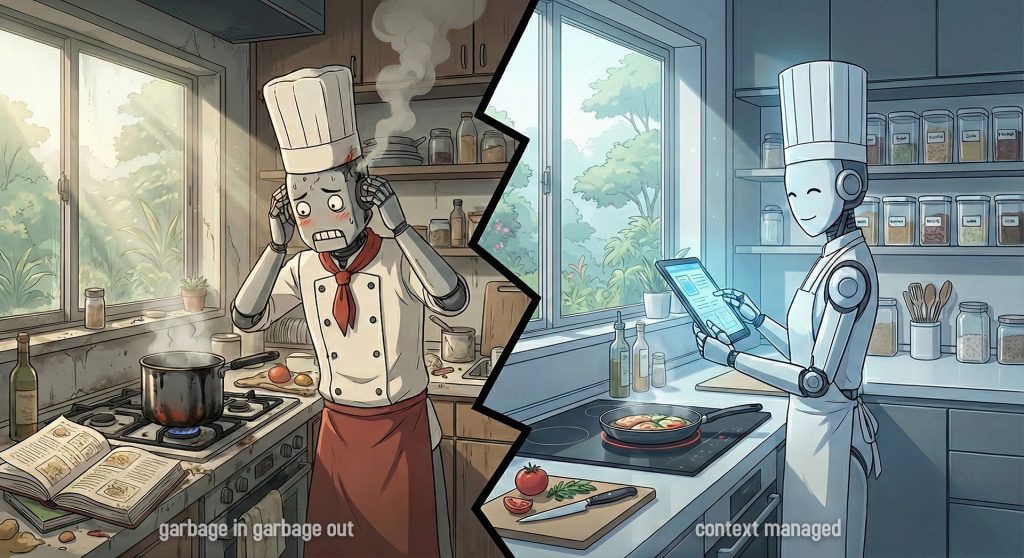
Here’s the brutal truth: No amount of prompt engineering can fix missing information.
Scenario: Q4 Sales Report
Perfect Prompt (No Data):
Act as a CFO with 20 years of experience. Write a comprehensive Q4
sales analysis with insights on trends, recommendations for Q1, and
executive summary. Use professional business language and include
data-driven insights.Outcome: ❌ Beautifully written fiction. The AI will hallucinate numbers, trends, and insights because it has nothing real to work with.
Basic Prompt (With Data):
Analyze this Q4 sales data and summarize key trends

[Attach Q4_Data.csv]Outcome: ✅ Accurate, factual summary based on real data. Not as polished as the perfect prompt would produce, but grounded in reality instead of hallucination.
The lesson: The bottleneck is no longer the instruction (the prompt). It’s the source material (the context).
The Chef Analogy
Think of it this way:
- Model = Master Chef 👨🍳
- Prompt = The Order Ticket 🎫 (“Make a steak”)
- Context = The Ingredients in the Fridge 🥩
Old Era (2024-2025):
You had to write the ticket precisely: “Cook steak, medium-rare, sear 2 mins each side, rest 5 mins.”
New Era (2026):
The Chef is a master. You just say “Steak.” He knows how to cook it.
The Problem:
If the fridge is empty (No Context), even the best Chef in the world cannot make you a steak. He can only serve you a picture of a steak (Hallucination).
Verdict: Stop trying to write better tickets. Start stocking the fridge.
But here’s the catch: You can’t just throw everything in the fridge and call it done.
The NotebookLM Problem: Context Dumping != Context Management
Remember my NotebookLM disaster? That’s what happens when you confuse having context with managing context.
What Went Wrong:
I imported multiple guides for the same system, each covering a different area:
- User Guide (complete, accurate, up-to-date)
- Configuration Guide (complete, accurate, up-to-date)
- Quick Start (complete, accurate, up-to-date)
- Ops Guide (complete, accurate, up-to-date)
- Troubleshooting FAQ (mixed topics across all areas)
Each document alone worked perfectly. The content was relevant, correct, and helpful.
But together? Chaos.
When I asked: “How do I configure user permissions?”
The AI couldn’t figure out which area of the system I was asking about. It would:
- Pull configuration steps from the Configuration Guide
- Mix in troubleshooting tips from the FAQ
- Add best practices from the Ops Guide that didn’t apply to my question
The result: A Frankenstein answer that was technically correct for each source, but completely useless for my actual question.
The AI had access to everything, but it couldn’t locate which document was most relevant to my specific question.
The Real Problem:
It’s not “Garbage In, Garbage Out” (GIGO).
It’s “Too Much In, Can’t Figure Out Which” (TMICFOW? Okay, that acronym doesn’t work 😅).
The AI had access to everything, but it couldn’t tell:
- Which area of the system I was asking about
- Which document was most relevant to my specific question
- How to disambiguate between similar topics across different guides
This is the context management problem: Not bad data, but unorganized data that the AI can’t navigate effectively.
What I’m Learning
I haven’t solved this yet. I’m still figuring out the best way to organize context so AI can actually use it.
But I know the direction: Context Management.
The questions I’m exploring:
- How do I structure documentation so AI knows which doc to use?
- Should I use separate NotebookLM projects by topic?
- How do I name files to make them more AI-friendly?
- What’s the right level of granularity for splitting docs?
- Can folder structure alone provide enough context clues?
Some ideas I’m testing:
- Organizing by topic/area instead of dumping everything together
- Using clear, descriptive file names that include the topic
- Being more explicit in my questions (“…for end users” vs just “how to…”)
- Selective importing – only bringing in docs relevant to the current task
I’ll share what I learn as I experiment.
The Two Skills Compared
2025: I focused on prompt engineering – how to ask better questions
2026: I’ll be put more effort on context management – how to organize knowledge so AI can use it
| Aspect | Prompt Engineering 💬 | Context Management 📁 |
|---|---|---|
| Focus | How you ask ❓ | What you provide 📦 |
| Skill | Writing better prompts ✍️ | Organizing information 🗂️ |
| Problem | “The AI didn’t understand me” 🤷 | “The AI couldn’t find the right info” 🔍 |
| Solution | Refine your question 🎯 | Structure your knowledge 🏗️ |
Both skills matter. But meta-prompts solved one problem. Context management is the next frontier and potentially the higher-leverage skill.
The Realization
I thought giving AI more context would automatically help.
Turns out, organized context is what matters.
It’s not enough to have all the information. The AI needs to be able to:
- Locate the relevant document
- Disambiguate between similar topics
- Navigate your knowledge structure
This is a different skill than prompt engineering. And I’m just starting to learn it.
What This Means 💡
If you’re using tools like NotebookLM, Notion AI, or any AI with document access:
The problem isn’t just what you ask.
It’s how you’ve organized what the AI has access to.
A perfect prompt with zero context = 🎭 Hallucination
A basic prompt with perfect context = ✅ Usable output
I don’t have all the answers yet. But I’m convinced this is the right direction. 😉